
Why it Was Mathematically Inevitable that Netflix Would Eventually Reinvent Basic Cable
Don't get too wrapped up in ad industry & streaming industry insider baseball. This was all simple to deduce years ago by looking at the economics at play.

Note: This is a long article and will probably hit the Gmail length limit, so you’ll want to visit Substack to read the whole post.
Well, look who’s reinventing cable TV.
It will be fun to watch the ad industry pundit class all simultaneously take off their “Linear TV is a Dinosaur that Deserves to Die” hats and put on their “Linear TV is Actually Super Smart” hats. They can use this article as a quick reference for their talking points.
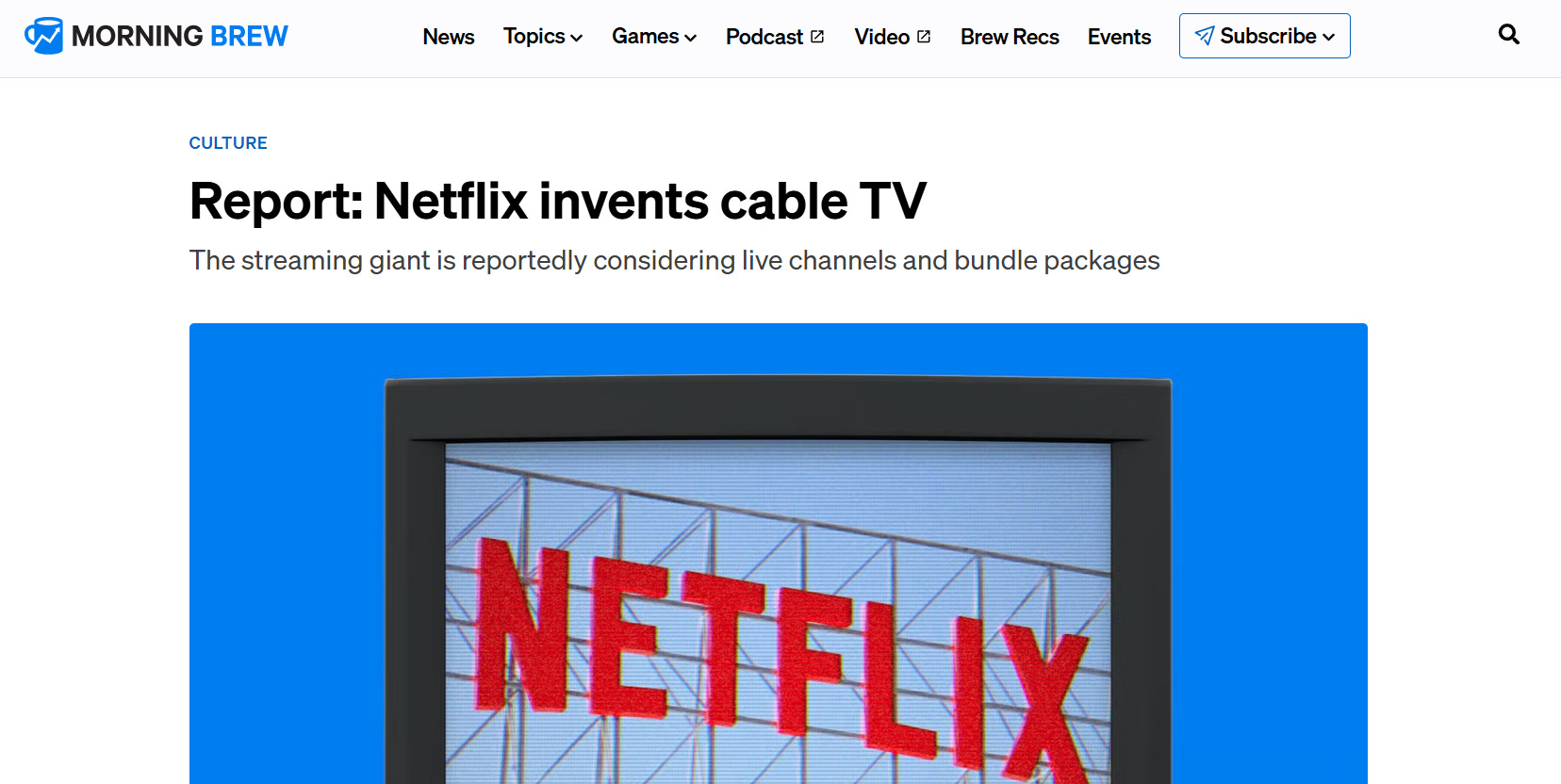
Indeed, there was a time around 2019 to 2021 when there was serious talk that no one would ever watch ads on TV ever again…I guess because Digital.
I’m painting with a very broad brush here, but Digital people tend to be technologists and technologists simply don’t understand advertising and scoff at the entire idea every chance they’re given. It never fails. Here’s my related rant on Elon Musk, advertising, and Tesla. But I digress.
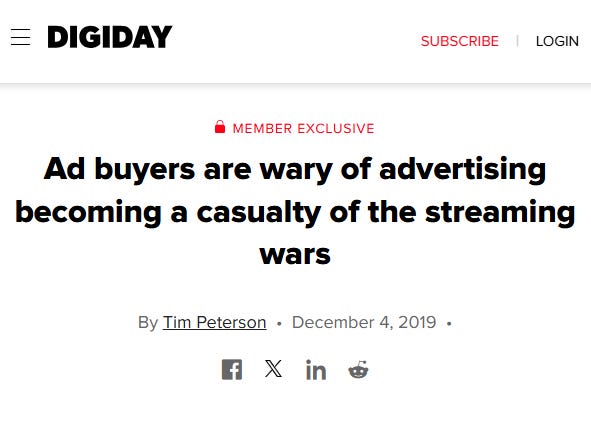
It was easy to predict in the 2019-2021 timeframe that this TV advertising doomerism was all a fad. Streaming was new and Disney+ had just launched to much fanfare, so —as usual [eye roll]— everyone got distracted by the newness and, in their excitement, forgot a bunch of basic economic and pricing principles. Forget the high-minded advertising and media theories; we’re just talking money and arithmetic here.
Here’s my reaction to that same Digiday article the very next day:
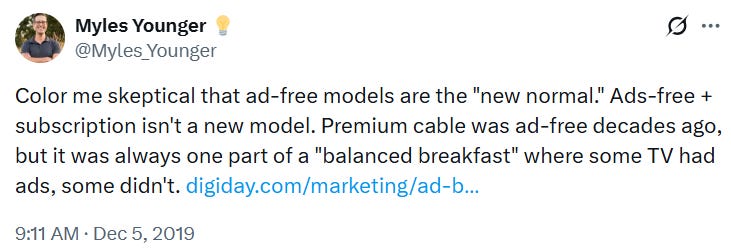
Why was I so confident about this almost 7 years ago? Read on and I’ll gladly explain! Frankly I’m surprised it’s taken so long for the reinvention of basic cable TV to take place. Trust me: more platforms are going to follow in the steps of Netflix because their ad sales teams will be leaving money on the table if they don’t.
Yes, this article is me doing a sad little victory lap over some sh*t I tweeted in 2019, but then again I think there are a bunch of factors that just aren’t very well understood and are worth explaining.
Here are the reasons that it was inevitable that Netflix would reinvent basic cable. I’ll dig into each in more detail:
Netflix needs to maximize its Price-Quality Frontier; a curve representing what all potential Netflix customers are willing to pay for in return for ad-free viewing and other amities.
On-demand binge-watching is economic poison for streamers. Netflix and other streamers will naturally push their customers away from it over time.
TV “channels” are a great way to repackage content for your ad sales team. This is an old trick in the content monetization and publishing game: curate thematic sub-collections of your existing content and sell it as a new SKU. Magic!
Choice fatigue is real when it comes to streaming libraries. People like stuff they can watch passively. TV is a means of relaxation. Channels play into this.
Generative AI and content saturation will continue putting a premium on live viewing and simultaneously erode the value of on-demand libraries.
Monetizing expensive content libraries by maximizing the Price-Quality Frontier
Not everyone is willing to pay the same price for a thing. This is an old idea. It’s why —for example— General Motors declared in 1925 that the company would offer “A car for every purse and purpose.”
Lots of people want cars, but they’re not all willing to pay a single, fixed price. Some people will pay more for a car, others less.
General Motors’ answer to this was to maintain five separate car brands, roughly grouped into price tiers, with Chevy being the most affordable and Cadillac being the most luxurious.

This is also true for entertainment. Not everyone is willing to pay the same amount for a streaming subscription. Some people don’t want to pay anything at all.
In exchange for flexibility on price, people will make trade-offs. For example:
Watching ads
Delayed access to new releases
Limited content libraries
Limited account sharing
So it holds true that streamers that only charge one price are sacrificing the customers that aren’t willing to pay that much. A lower-priced tier with trade-offs will capture some of those potential subscribers. An even lower-priced tier with even more trade-offs will capture more incremental subscribers. And so forth.
We can plot this as a “Price-Quality Frontier”—a curve that represents what people are willing to pay for at what price points, and what trade-offs they’re willing to make in return for discounts.
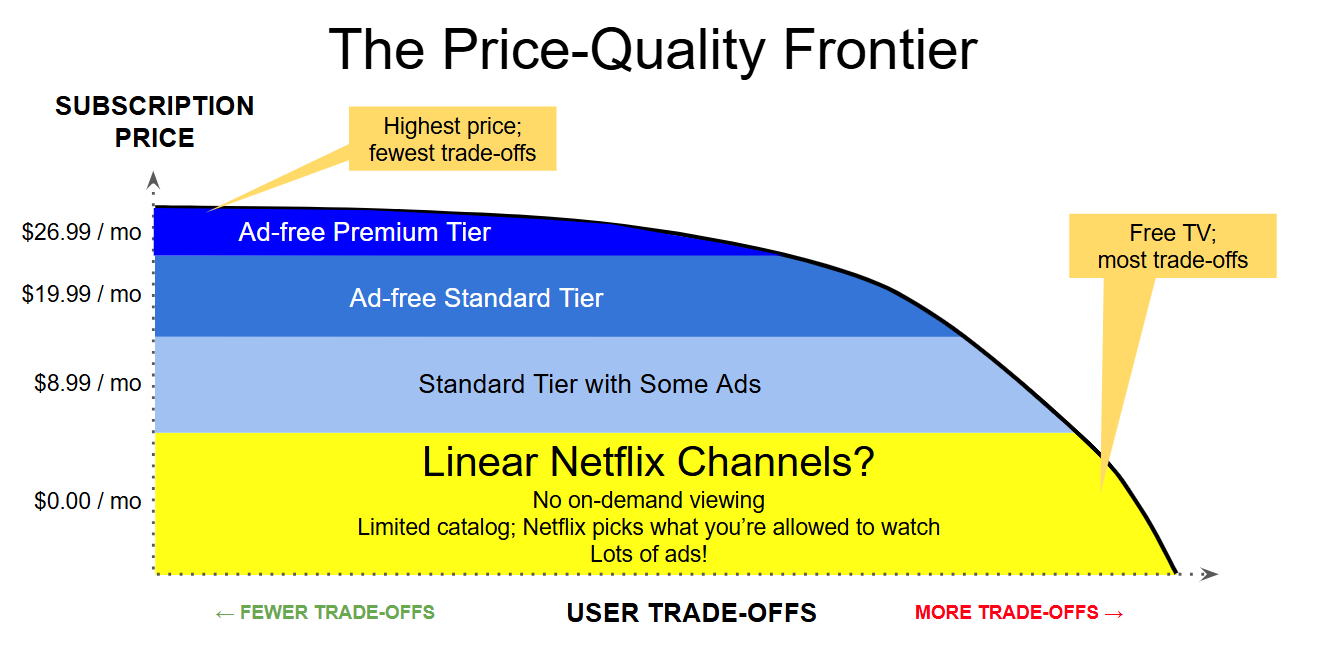
And guess what? No matter what you charge or how many subscribers you have, your content library still cost you a fortune to produce or license in the first place. Movies and professionally-produced shows are expensive and represent a very high fixed cost. Therefore it’s absolutely critical for content owners to find the most efficient possible combination of monetization options that collectively maximize revenue and profit.
This means that a streamer like Netflix will only maximize its revenue when it can monetize as many zones of the Price-Quality Frontier as possible. The most efficient and revenue-maximizing approach will push the boundaries on the trade-offs its viewers are willing to make (or the amenities they expect) in exchange for flexibility on price.
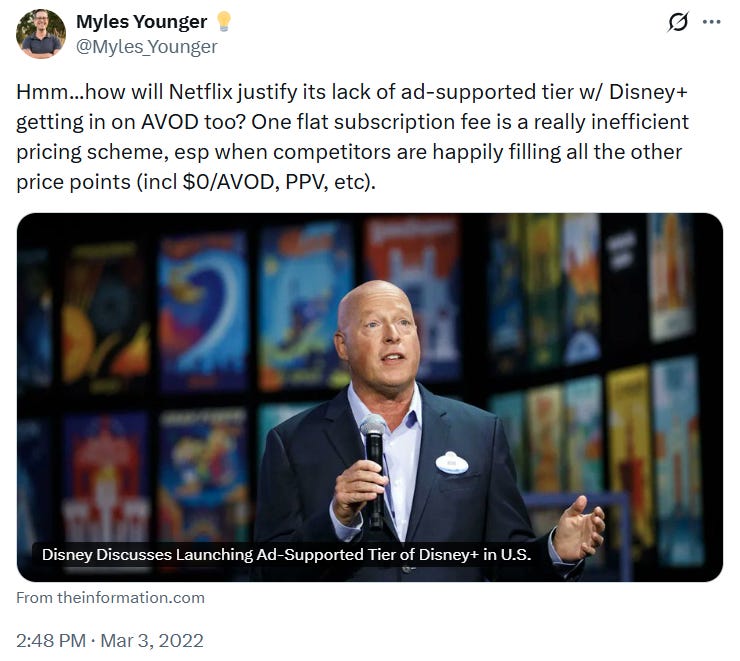
The obvious way to monetize the potential subscribers who don’t want to pay anything for Netflix content is to have sponsors and advertisers subsidize the missing subscription fees and show ads to viewers.
However, Netflix already has a paid tier with ads. So what to do?
A totally free tier will probably have more ads crammed into the viewing experience, but another variable Netflix can play with is user choice. This is a brilliant aspect of linear TV and the concept of “channels”: it removes some (but not all!) user choice in a format that is generally liked by people who want free TV programming. Multiple theme-based “channels” give viewers some control and choice.
And to think this was all invented decades ago in the previous century!
Binge-watching is economic poison for streamers and content owners
Allowing subscribers to binge through all-you-can-eat catalogs of expensively-produced shows and movies won’t last forever. It makes very little long-term business sense.
There are really two factors at play:
1 - Maximizing the lifespan of entertainment IP
Binging cuts deeply into the lifespan and emotional/cultural impact of entertainment IP. Entertainment content has very, very high up-front costs. It’s just part of the business. Before you’ve sold a single subscription, ticket, song, book, licensing deal, or anything else, you’re already deep in the red. You don’t make money by constantly producing new IP because most movies and shows will fail to turn a profit; you make money by milking IP that’s already proven popular and throws off higher and higher profit margins over the years. And hit properties like Star Wars and Seinfeld, James Bond and Jeopardy! come along pretty rarely.
Binge-watching could not be more anathema to the entertainment industry’s need for disciplined multi-year planning, long IP lifespans, and long-term emotional investment from audiences. When a fickle streaming subscriber binge-watches a show in a weekend and then moves on, the streamer captured a negligible amount of low-margin (or even negative-margin) subscription revenue while at the same time sacrificing years of future high-margin engagement.
I could write a whole post on this, but I’ll stop here. Binge-watching is a consumption pattern that is at odds with the production economics. It’s utterly unsustainable for streamers and the entertainment industry.
2 - Minimizing instant gratification and reducing subscriber churn
Related to the above, binge-watching simply means that subscribers will exhaust the value of the streaming platform catalog faster. And the faster the value dries up for a given subscriber, the faster they will churn.
Linear and appointment-based TV is pretty brilliant in this respect: it always gives viewers a reason to keep coming back. Just because it’s technically possible to now offer complete video catalogs for on-demand, all-you-can-eat consumption doesn’t mean it makes business sense.
Even keeping subscribers an extra few weeks on average would make a massive financial difference to any streamer. This means that streamers must start holding things back. Many have already pivoted to models where new episodes of shows are dripped out weekly. A logical next step is to launch linear “channels” that nurture appointment-based viewing relationships that last longer (and develop a deeper emotional connection) than binge-watching.
TV “channels” are a great way to repackage content for your ad sales team
A TV channel is a curated set of entertainment content. Curation adds value in a number of ways. This value translates to easier ad sales and/or higher premiums paid by advertisers.
Theme- or demographic based TV channels mean engaged, targeted, segmented viewers. Advertisers love this. If I have to explain why, you’re reading the wrong blog.
From a purely subjective standpoint, curation can add a lot of “sizzle” to an otherwise static content library. You can create exciting branded channels like Netflix ACTION, Netflix HEIST, Netflix BABY, Netflix COOKING, or Netflix BRITISH. You can re-use the same content across multiple channels and magically create value because you packaged it and branded it.
Free TV channels give advertisers a way to target net-new eyeballs and add incremental reach. Potentially this would include viewers that advertisers cannot target on paid ad-free streaming platforms. For example, a household might be ad-free on Disney+ but might be perfectly happy to watch ad-supported free Netflix channels. This is a win for Netflix ad sellers.
From a very tactical perspective, if you’re selling ads and sponsorships, it never hurts to have new SKUs to talk to advertisers about. Repackaging existing content into new SKUs is a very old page out of the content monetization playbook.
I’ll pause while a few of you copy/paste those bullets into an email to your Board.
And while I’m on the subject: I truly expect YouTube to adopt this approach and launch curated linear channels using content from its top creators. Given that the majority of YouTube viewing now happens on televisions, it makes a ton of sense and would allow YouTube to create new premium TV ad inventory practically out of thin air.
But look: TV invented all this decades ago in the previous century. I’m not saying anything new. There were probably radio people in the 1950s ranting about how the TV people were stealing their ideas from the 1920s.
Choice fatigue is real
Just because you can give viewers access to an exhaustive on-demand content library doesn’t mean you should.
![Streaming Catalogs for Stremio: Netflix, HBO & More [2026]](https://substackcdn.com/image/fetch/$s_!q9f0!,f_auto,q_auto:good,fl_progressive:steep/https%3A%2F%2Fsubstack-post-media.s3.amazonaws.com%2Fpublic%2Fimages%2F0a0b10a7-2d0b-4a01-8eae-c7fe2c5d1e58_768x432.jpeg "Streaming Catalogs for Stremio: Netflix, HBO & More [2026]")
On-demand course catalogs are trying to force an active UX into an experience that is ideal when it’s passive. When people watch TV, they want to settle back into their couch and relax. This mis-match is visible in all kinds of statistics.
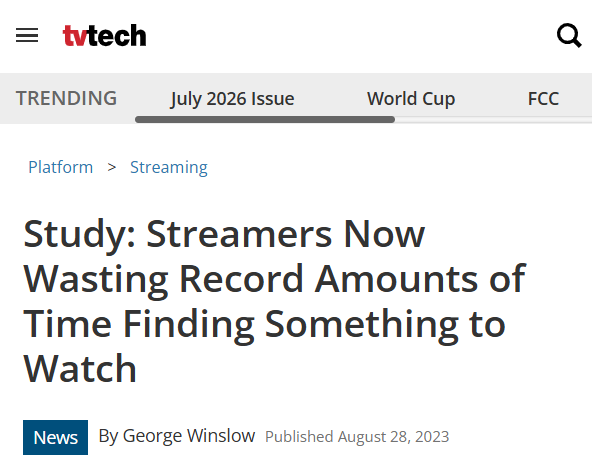
There are a number of downsides for streaming platforms:
Decreased emotional engagement from viewers who are overly pre-occupied with navigating the UI. This has an intangible but real long-term financial impact. Emotional connection is the profit engine of the entertainment business.
The erosion of perceived platform value. This will be largely subliminal, but it does play a measurable role in how consumers spend their streaming time and money. A 2024 study found that about half of people strongly consider a streaming platform’s UI when deciding whether to subscribe. Many platforms have addressed this by making smaller and smaller marginal improvements to their recommendation algorithms. TV channels are a much lower-tech and simpler solution to the same problem. 🤷♂️
Viewers who are endlessly browsing aren’t watching ads. OK maybe they’re seeing a homescreen ad here or there, but in general if you’re trying to monetize content, you want people watching the content. Every extra minute viewers are spending in “browse mode” comes straight out of a streamer’s bottom line.
TV channels are a great compromise. Viewers have some control: they can change the channel. But the channel itself just has something “on.” You start watching and within seconds you’re nicely zoned out. If you think about what TV viewers want from entertainment, this is an ideal, relaxing experience.
Choice is a mirage anyway. Not only do people not mind having choice taken away from them, they actually prefer it! Ask any good UX designer. This is another topic you could write a whole book about, but I’ll move on.
Generative AI and content saturation will continue putting a premium on live TV viewing
This last point is more thematic and unpacks in too many directions to fully cover here. For example, I wrote about live, shared experiences with respect to AI in this April 2026 post on OpenAI’s acquisition of TBPN.
Generative AI means that the cost of content production will generally get lower. This means that the barrier to offering a content catalog (a bank of shows and movies) will get lower. Content catalogs will get gradually more commodified. This means that there will be downward pressure on the amount people will pay to access content catalogs, and the rates (CPMs, etc) advertisers will pay as the supply of available content continues to balloon.
This is already happening as streaming platforms have unleashed thousands upon thousands of hours of on-demand content over the past decade to a fickle viewing public with little loyalty to any one platform.
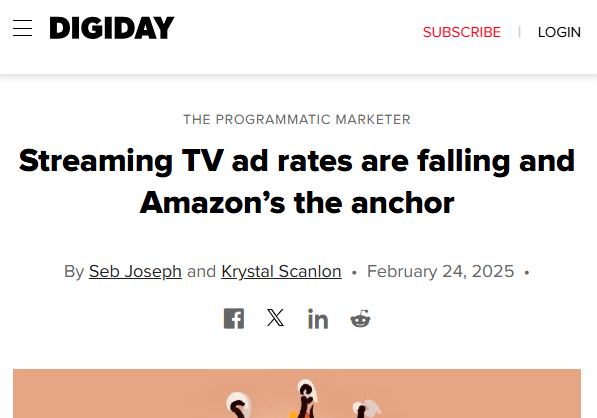
There are many other variables at play and many counter-moves content owners can make. But generative AI will add to this kind of downward pressure over time.
A key variable for content owners to control is 'live-ness' or the degree of synchronicity required to enjoy a piece of media. By dictating which content must be consumed at an appointed time versus what can wait, platforms can dictate the urgency and attention a viewer must bring to the screen.
This has already been happening with live sports. This is likely unrelated to AI, but it’s a “teachable moment” on the value of engaging live content.
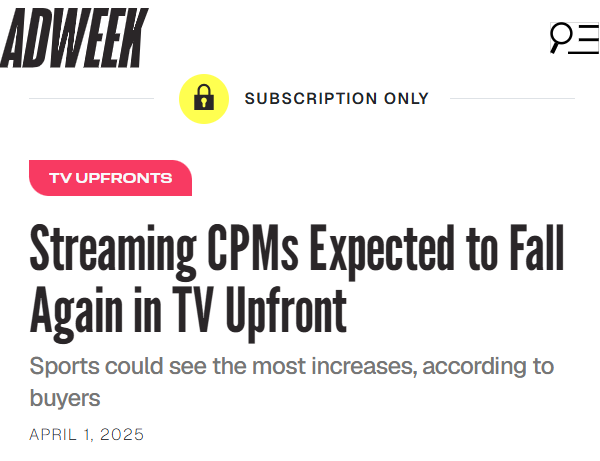
Here’s the thing: sports is only one type of content and not everyone watches sports.
But the shared cultural moments of live sports viewing are near-priceless in the “post-monoculture” 21st century. I write this in the midst of the 2026 World Cup which has, wow, been a global cultural and entertainment touchstone in a way we haven’t experienced for many years now. I’m not even a soccer fan and I’m vicariously basking in the glow. Ditto the Knicks vs. Spurs in the NBA finals. I don’t follow basketball and even I was inundated with awesome fun basketball content.
So how do content owners and streaming platforms cultivate shared experiences and cultural moments for all the people who aren’t sports fans?
In terms of programming, that’s a topic for another blog post. But the form factor needs to be linear. Linear TV channels are a great option here as they offer an always-on formula for live, appointment-based viewing. The alternative looks more like pay-per-view where streamers would have to create urgency around live events one by one. This can pay off for a small handful of intensely-hyped events (e.g., one or two per year), but it’s not an efficient, repeatable approach if the goal is to build a steady, predictable stream of ad revenue.
That’s all for now
Well that turned out to be a very long post! I hope you enjoyed it. A lot more could be written on this topic. I didn’t really have the time or energy to get a little more "mathematic” and model additional efficiency curves, content payback timelines, and so forth. But my point from the introduction stands: some of this is about the entertainment & advertising business, but a lot of it is based on generalized principles of pricing efficiency and payback on high fixed costs.
Bye!